

‘To wear dreams on one’s feet is to begin to give a reality to one’s dreams.’ – Roger Vivier
- Cianán Ó hANLUAIN
- Feb 19, 2022
- 3 min read

Shoes in today’s culture are one of the purest forms of self-expression. Shoes have evolved from functional protection for our feet and a mode of transport, to a form of fashion and individualism. Over the last two decades there have been small improvements to functionality of shoe design for increased performance and inclusivity ( such as Nikes self-tying shoe laces and hand-free shoe),



Nike's Self Lacing and Hands Free Shoes
This leaves the redesign of most shoes to aesthetic changes. It should be noted, this does not mean these aesthetic changes are superfluous, on the contrary, they are needed. The contribution of waste from the shoe industry has never been higher.
According to The Centre for SMART (Sustainable Manufacturing and Recycling Technologies), in the UK 142,756 tonnes of shoe waste go to landfill.
This is simply not good enough and must be a driver of change of design choices made in designing shoes. Their must be more conscious material choices made. A good example of these conscious choices, is the brand Veja, who use high-quality recycled materials, organic cotton, and sustainably-sourced leather. Another example is the Adidas initiative of using their new ‘Plastic’. Parley Ocean Plastic® is created from upcycled marine plastic waste that is intercepted from remote islands, beaches and coastal communities

Adidas x Parley Ocean Plastic® Shoe
Material choice and the innovation in shoe design was discussed with Caoimhe Kelly, A Senior Designer at Timberland Footwear and Design Consultant, as a guest lecturer. Caoimhe explained that shoe design not only consists of designing for the next fashion season but simultaneously designing with the scope of the next 2-3 years. She described how this is achieved by breaking down the typical design department. Explaining that there is a team who designs short-term, a team who innovates and designs for the long term, and how there is a third team ensuring that the brand identity is followed and promoted by both teams. This was very interesting to think about my own future job prospects, as it shows that not only is it important to consider the company, what they design, and their brand identity… but also where within that company you apply, as the scope could be so different.
This workshop was inspiring, I am always excited to meet people who have studied product design and are now working in industry. It was interesting to hear about the vast career opportunities we have as product designers and how we can go into whatever niche we feel suits us!
We were set a design challenge to design a new shoe for the Autumn 22/23 season for our designated shoe brand. The group I was in was given Doc Martens. This challenge gave huge insight how these groups function and innovate. I found it essential to look back on the Doc Marten past before looking at its possible future. We did a brief history analysis before looking at the material and form changes ( or in Doc Martens case, the lack there of!).
It was interesting seeing the different groups and cliques in society who have adopted Docs into their look book, From the skin-heads, to punks and to the norm-core of today. However the iconic Doc marten boot has barely ever changed. It is still tough leather with its iconic yellow lace. I learnt a lot about design in then. That design is honest, transparent and stays true to itself. The Doc never changed to catch on to a new wave or fashion phase. It stayed put and allowed fashion come to it. It stuck to its Brand Identity and believed in its appeal to users.

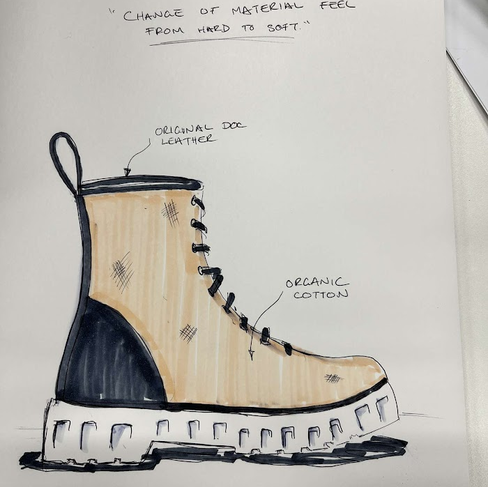


My Shoe Design for Doc Marten's Autumn 22/23 Collection, I decided to play with Doc Marten's notorious hard leather by changing it with a an organic cotton canvas mixed with the iconic hard leather. My second design was to push Doc's Utilitarian design.
I learned lots about design this week from the workshop and Caoimhe: the best practices of design and shoe design, but especially our identity as product designers. I knew nothing about shoe design before this workshop, however, the core principles are similar to industrial design and can be applied from what we learn in product design. It also exposed me to the numerous soft skills we have developed as product design students such as; teamwork, communication and initiative. These are important skills and are valued in any industry I work in.


Comments